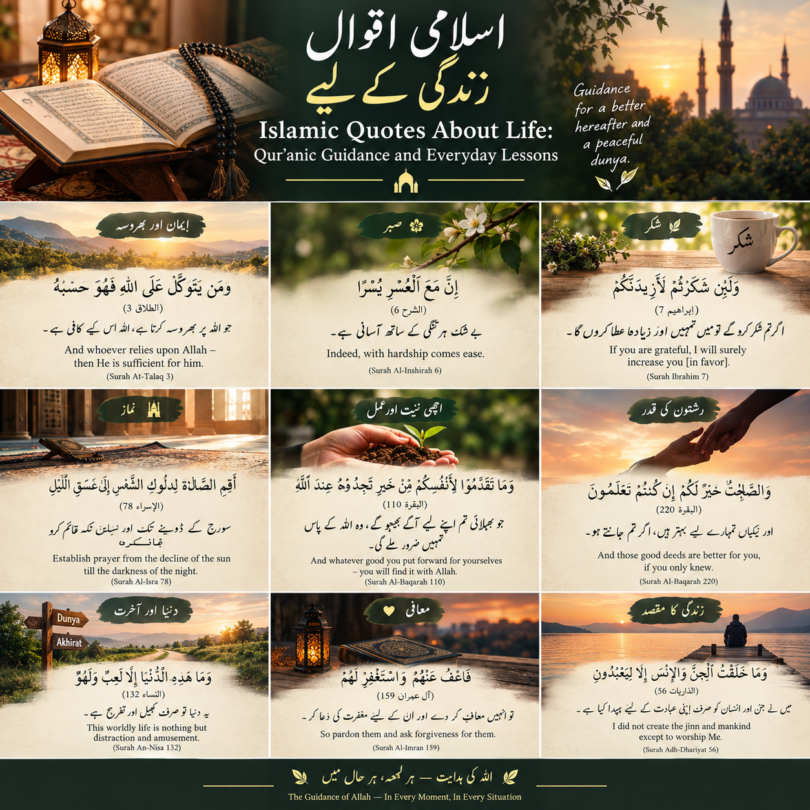

Islamic quotes about life remind Muslims that life is a temporary trust from Allah, a test of character, and an opportunity to worship, serve others, and prepare for the Hereafter. The Qur’an and Sunnah offer guidance for both difficult and joyful moments, teaching patience during hardship, gratitude during ease, and trust in Allah when the future is uncertain.
The references below are organized by theme. Short explanations are included to make each lesson easier to apply in daily life.
Important: A Qur’anic verse or authentic hadith is different from a modern inspirational quote. When sharing religious words, always check the source and avoid attributing an unverified saying to Allah or the Prophet Muhammad ﷺ.
1. Life Is a Test, Not a Measure of Your Worth
Qur’an 67:2 teaches that Allah created death and life to test which people are best in their deeds.
This does not mean that every difficulty is a punishment. Hardship can test patience, reveal character, remove arrogance, or bring a person closer to Allah. Success is also a test because wealth, health, influence, and free time all carry responsibility.
Everyday lesson:
Instead of asking only, “Why is this happening to me?” also ask, “What response would please Allah in this situation?”
2. Hardship Is Not Permanent
Qur’an 94:5–6 repeats the message that with hardship comes ease.
The repetition offers reassurance, but it does not promise that every problem will disappear immediately. Ease may come through a solution, a change in circumstances, emotional strength, helpful people, or a deeper connection with Allah.
Practical reminder:
During a difficult period, focus on the next right action rather than trying to solve your entire future in one day.
6. Your Purpose Is Greater Than Achievement
Qur’an 51:56 states that Allah created jinn and humankind to worship Him.
Worship is not limited to formal prayer. Lawful work, caring for parents, supporting a family, helping a neighbor, earning honestly, and avoiding harm can all become meaningful when done with a sincere intention.
This gives ordinary activities spiritual value. A person does not need fame to live a purposeful life.
Ask yourself:
“What intention can I improve in this task?”
7. Trust Allah After Taking Responsible Action
Tawakkul means relying on Allah while still taking appropriate steps. It does not mean refusing to plan, work, seek advice, or use available resources.
A balanced approach is:
- Understand the situation.
- Take lawful and sensible action.
- Ask Allah for guidance.
- Accept that the final outcome is not completely under your control.
This approach is especially helpful when making decisions about work, marriage, education, health, or family responsibilities.
8. Good Character Is Part of a Successful Life
Islamic guidance about life is not only about personal worship. It also includes how people treat one another.
A meaningful life requires:
- Speaking truthfully.
- Keeping promises.
- Avoiding unnecessary humiliation of others.
- Forgiving when forgiveness is appropriate.
- Protecting people’s privacy.
- Showing kindness without expecting public praise.
A person may collect achievements and possessions, but character determines how those blessings affect other people.
9. Success Is Not Only Measured by the World
Modern culture often defines success through income, appearance, popularity, or professional position. Islam gives a wider definition.
Success includes:
- Faith with sincere action.
- Halal earnings.
- Good treatment of people.
- Patience during difficulty.
- Gratitude during ease.
- Repentance after mistakes.
- Preparing for the Hereafter.
A person can experience a worldly setback and still be successful in the sight of Allah if they respond with honesty, patience, and faith.
10. A Difficult Day Does Not Define Your Whole Life
Islamic teachings encourage hope without promising a life free from tests. One failure, rejection, illness, financial problem, or painful relationship does not represent the entire story of a person’s life.
A useful spiritual response is:
- Make du‘a.
- Review what can be learned.
- Repair any wrong you caused.
- Seek advice from trustworthy people.
- Take one practical step forward.
- Leave the result to Allah.
This combines faith with responsibility rather than treating optimism as passive waiting.
Islamic Terms About Life
- Sabr: Patient perseverance during difficulty.
- Shukr: Gratitude shown through the heart, words, and actions.
- Tawakkul: Reliance on Allah after taking responsible action.
- Amanah: A trust or responsibility given to a person.
- Dunya: The present worldly life.
- Akhirah: The eternal life after death.
- Niyyah: The intention behind an action.
- Taqwa: Consciousness of Allah that influences choices and behavior.
How to Use Islamic Quotes Responsibly
Before sharing an Islamic quote online:
- Check whether it is from the Qur’an, a hadith, or a modern reflection.
- Include the surah and ayah number for Qur’anic verses.
- Name the hadith collection when quoting a hadith.
- Avoid using “Allah says” unless the wording is genuinely from the Qur’an.
- Do not present a popular social-media quote as a religious ruling.
- Preserve the meaning and avoid editing words in a way that changes the message.
Frequently Asked Questions
What do Islamic quotes say about life?
Islamic teachings describe life as a temporary trust and a test in which people are given opportunities to worship Allah, develop good character, help others, and prepare for the Hereafter.
What does Islam say about hardship?
Islam teaches that hardship is part of the human experience and encourages patience, prayer, responsible action, and hope in Allah. The Qur’an also reminds believers that ease accompanies hardship.
What is the Islamic purpose of life?
According to Qur’an 51:56, human beings were created to worship Allah. This purpose includes formal worship as well as sincere, lawful actions that benefit oneself and others.
How can I apply Islamic life lessons every day?
Begin with small practices: pray consistently, express gratitude, control harmful speech, fulfill responsibilities, help someone, and review your intentions before important actions.
Are all online Islamic quotes authentic?
No. Some online quotes are modern reflections, unattributed sayings, or community-added content. They should not automatically be treated as Qur’an or hadith.
What is the difference between a Qur’anic verse and an Islamic inspirational quote?
A Qur’anic verse is part of the revealed Qur’an and has a specific reference. An inspirational quote may express a beneficial idea, but it is not automatically revelation or a statement of the Prophet ﷺ.